All-in-one Duplex (AIO-DX) Configuration
The AIO-DX configuration is a compact, high-availability deployment model consisting of two All-in-One (AIO) nodes, each performing compute, storage, and control functions.
Architecture:
Includes 2 controller nodes and up to 50 worker nodes. As illustrated in the network diagram, these controllers are interconnected through multiple networks, including OAM, public, data, management, and cluster host ensuring robust communication and operational resilience. Fault tolerance is achieved through active/standby redundancy between the controllers, while external systems or the higher-level architecture may provide additional resilience needs.
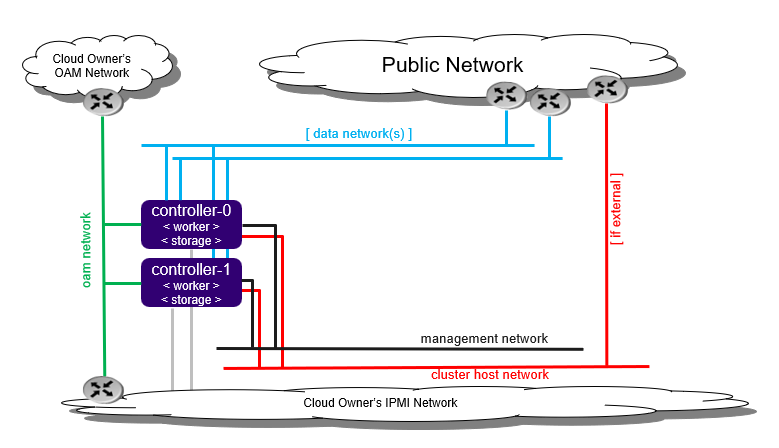
See Deployment Configuration Terminology for a description of common deployment configuration terminology, including definitions of different node types and network types.
Typical Deployment:
Ideal for environments that require higher service availability and processing power.
Storage Options:
A local internal Rook-managed Ceph cluster (in Controller Deployment Model) using one or more disks for OSDs.
External storage backends can be configured as an alternative or in addition to the local Rook-managed Ceph cluster. Supported external backends are:
External NetApp Trident backend
External Dell Storage Array backend
Networking:
On an All-in-One Duplex system, two modes of connection are supported for the management and cluster host network:
Direct
This mode uses direct peer-to-peer connections between the two nodes for the management and internal cluster host network, eliminating the need for a ToR switch port for these networks.
StarlingX recommends a 10GE shared management and cluster host network with LAG for direct connections.
If the management network must be 1GE (to support PXE booting), then a separate 10GE cluster host network with LAG is also recommended.
Switch-Based (Recommended)
This mode uses a ToR switch to complete the management and cluster host network connections. In this mode, the cluster host network can optionally be used for external connectivity, if required.
External connectivity is provided through the OAM network or optional data networks.
Extend AIO Duplex Capacity
Up to 50 worker nodes can be added to the AIO-DX deployment, allowing a capacity growth path if starting with an AIO-DX deployment.
See System Engineering Guidelines, System Limits, Benchmarks, and Testing documentation for the maximum number of additional worker nodes supported in an AIO-DX deployment configuration.
The extended capacity is limited compared to a Standard Deployment Configuration, as the controller/worker function on AIO controllers uses only a portion of the server’s overall processing power.
Hosted application containers can be scheduled on either of the AIO controller nodes and/or the worker nodes.
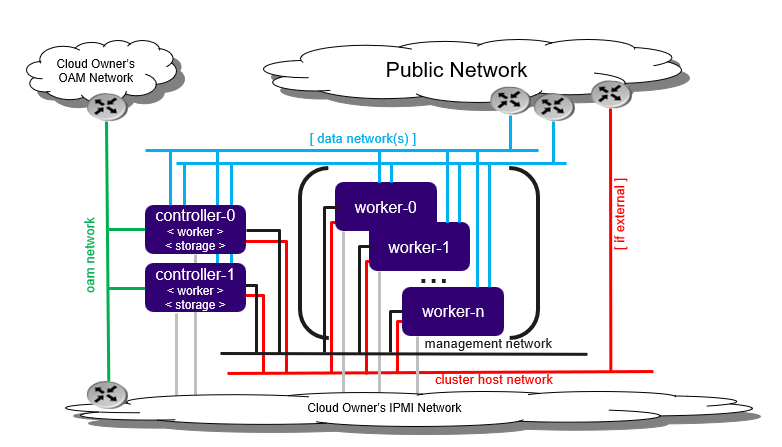
Note
With Rook, the storage function can be distributed over both controllers and workers in this configuration.
